
Case Studies
Friends on the Block Research Projects
Friends on the Block (FOTB) was developed to make Science of Reading instruction accessible to all learners, particularly students with intensive literacy needs. The program has been developed and evaluated through multiple federally funded research projects, including single-case design studies and randomized controlled trials. Across two randomized controlled trials involving 132 students, those receiving FOTB consistently outperformed comparison students on key reading outcomes. In the first study, FOTB students demonstrated statistically significant advantages over comparison students in word recognition, phonics, comprehension, and other literacy skills after 42 weeks of instruction. A second study replicated the overall pattern of findings, demonstrating meaningful gains in word reading, along with positive effects on reading fluency and comprehension. In both studies, over half the FOTB participants completed the entire program in 42 weeks or less.
The following case studies are a closer look at some of our study participants and how they responded to
Friends on the Block's special features and customizability.
Table 1
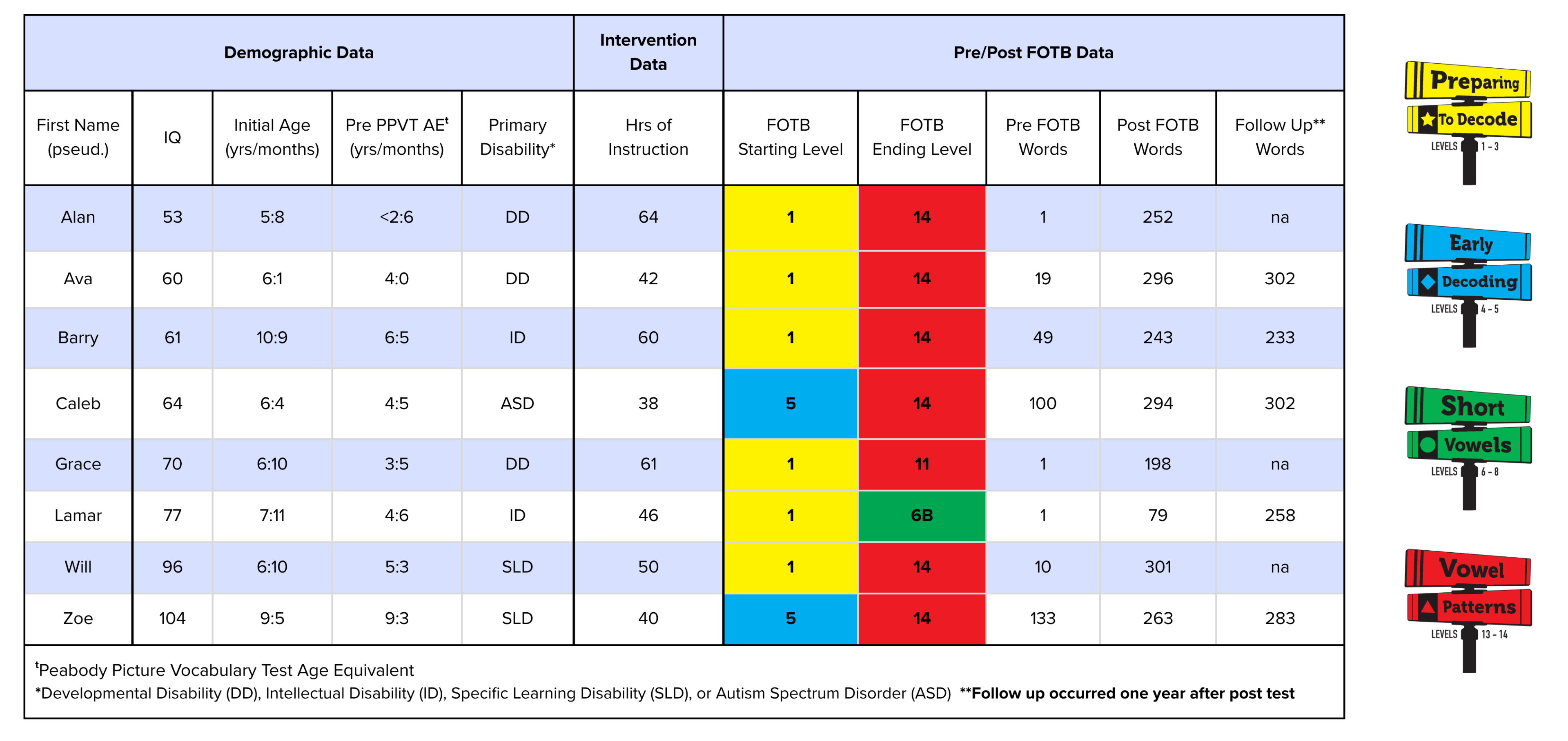
Table 2
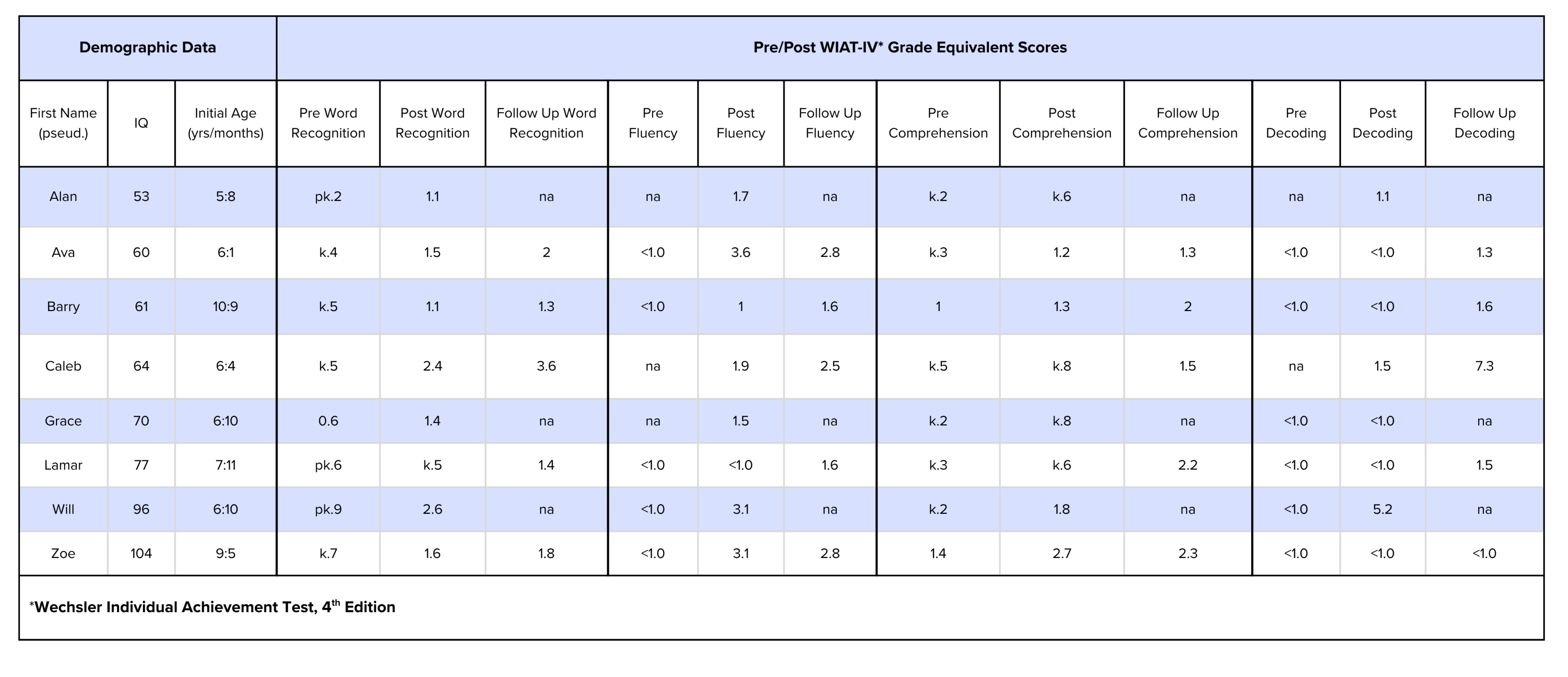
Note: Grade Equivalent Scores provide a comparison with students in the norming sample but do not necessarily indicate mastery of all skills at a given grade level. These are displayed here for illustrative purposes; raw scores were used in data analyses.
Meet Will
Specific Learning Disability
Age: 6 years, 10 months | IQ: 96 | Pre PPVT Age Equivalent: 5:3 (years:months)
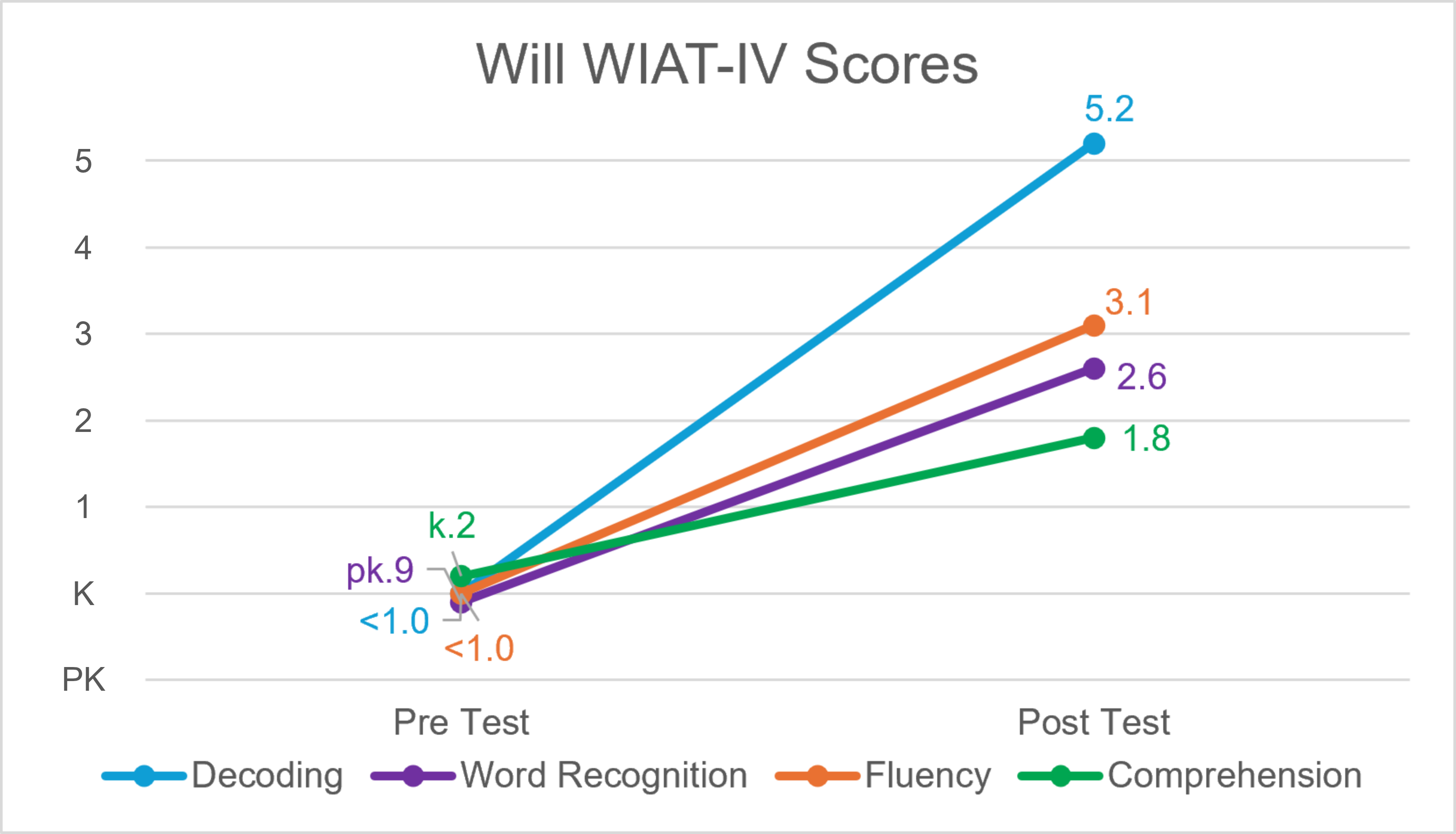
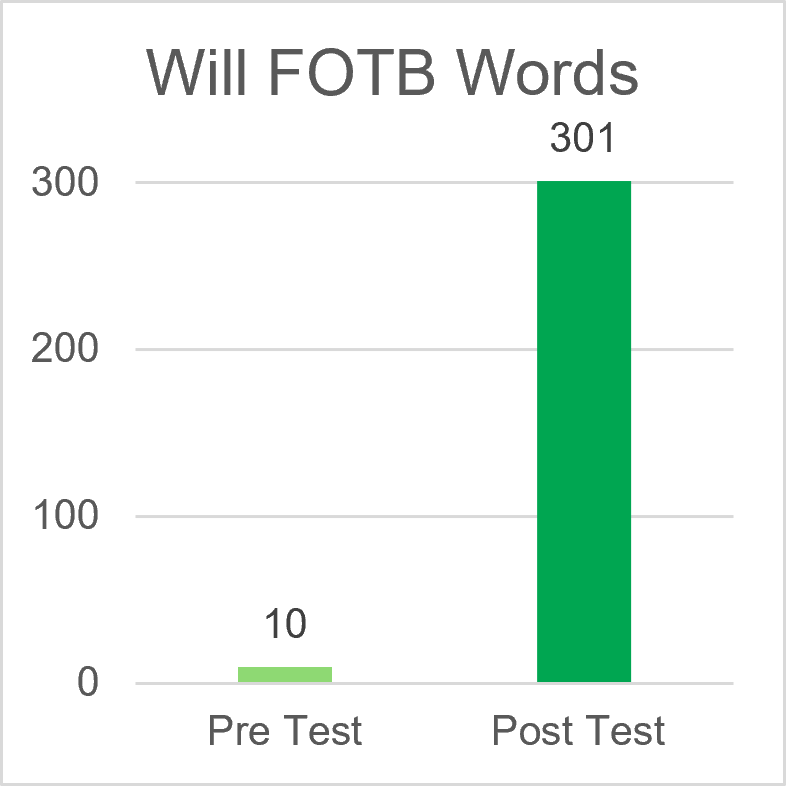
Note: this graph uses a larger scale due to the student's exceptional acheivement
Text Sample
Friends on the Block Fluency Building Passage
Level 14, Earth Day Chapter 1
"Ms. Green stood by her desk and said, 'It is Earth Day! Earth is
our home. It's the only place we have to live. We can’t just move
to a new place to live if we don’t take care of the world. On this
day we think about how much we love the world and what we
are able to do to save it. We can stop doing things that hurt the
world. There are some things we need to start doing to help it.
We can’t save the world all alone, but don’t worry. Everyone can
find some ways to help save the world.'"
Progress and Engagement in FOTB
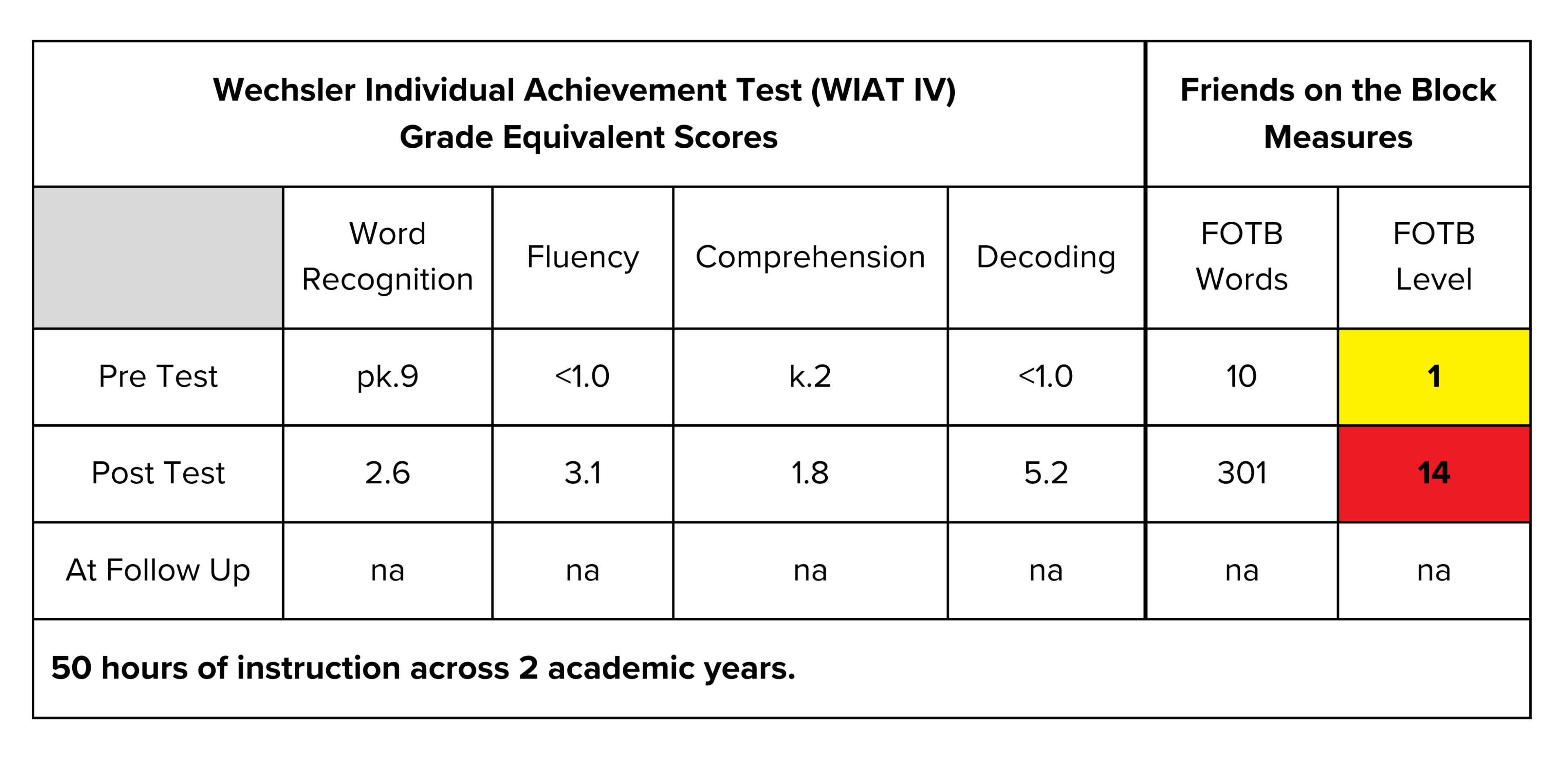
In late October of first grade, Will began Friends on the Block (FOTB) instruction at Level 1. On the FOTB Target Word and Placement Test, he knew only 10 words and did not know the words in Level 1. Will was highly engaged in the lessons and progressed through the curriculum quickly. He spent only one week on each of the first 5 levels, learning approximately 40 new words and was able to sound out simple CVC words (e.g., at, and, dad) by early December. By October of second grade, he had successfully completed all 14 FOTB levels (28 weeks; 50 hours of instruction).
Academic Achievement
As shown in the table and graphs, Will made substantial gains from pretest to posttest in decoding, word recognition, fluency, and comprehension. At pretest, his grade-equivalent scores in each of these areas indicated performance similar to that of a student in pre-kindergarten or kindergarten. At posttest, Will’s grade-equivalent* scores indicated that he performed similarly to a student early in fifth grade in decoding, the middle of second grade in word recognition, early third grade in fluency, and late first grade in comprehension. He demonstrated growth during the lessons in his ability to retell stories. On the CUBED Narrative Language (Petersen & Spencer, 2016) measure administered at posttest, he read first-grade text at 82 words per minute with 96% accuracy and correctly answered 12/12 comprehension questions. On second-grade text he read 74 words per minute with 96% accuracy and correctly answered 9/12 comprehension questions.
Response to Lesson Features and Customization
Will's progress illustrates the importance of combining a carefully sequenced instructional approach with customized review and practice. Although he acquired new Target Words and decoding skills quickly, he benefited from cumulative review to strengthen retention and distinguish between similar words. His teacher selected Learning Games to provide additional practice with segmentation and spelling while reinforcing the skills he was learning in lessons. These features allowed instruction to respond to Will's developing skills while maintaining the sequence and instructional content of FOTB.
Although Will quickly progressed through FOTB, learning the Target Words in each level, it was clear that he also needed the careful sequencing and customized cumulative review to retain the words he was learning and consistently discriminate between similar words. For example, want is learned in FOTB Level 1 and what is introduced in Level 5. Like many struggling readers, Will confused these words and needed extra practice with them. Similarly, at Level 7, he would confuse who and how. With practice, he was able to consistently discriminate between words that were similar, demonstrating his growing ability to fully process the complete spellings of words.
Will also developed decoding skills very quickly. Initially, he only knew a few letter-sounds and his phonemic awareness skills were weak and inconsistent. In just 6 weeks, Will had learned most of his letter-sounds and was sounding out words with short vowels. As phonics skills increased in difficulty (e.g., see the FOTB Target Word and Phonics Skills List), his teacher chose Learning Games to further reinforce segmentation and spelling of words with the new letter patterns. These Learning Games, particularly the card games Go Fish and Memory, helped Will retain the words he was learning and provided opportunities to practice cooperating with peers.
During his final week of instruction, Will demonstrated his increased fluency and accuracy as he read a Level 14 FOTB passage at 93 words per minute with 97% accuracy during the Fluency Building Routine. Sample text from this passage is in the left column.
*Note: Grade equivalent scores provide a comparison with students in the norming sample but do not necessarily indicate mastery of all skills at a given grade level.
Meet Zoe
Specific Learning Disability/Dyslexia
Age: 9 years, 5 months | IQ: 104 | Pre PPVT Age Equivalent 9:3 (years:months)
Text Sample
After FOTB instruction, Zoe read the passage below accurately (97% accuracy) and fluently (133 words per minute).
Friends on the Block Fluency Building Passage
Level 13: Road Trip
"I like to take a road trip each year with my family. A road trip is
when you take a trip, but you drive there. Sometimes we take
long trips. Sometimes we take short trips. My family has lots of
fun on our road trips. We like to spend time together. Before we
go, there is a lot to do to get ready. First, we look at the map and
make a plan. We find our house and then we find the place we
want to go. We will follow the map, but if we come up with a new
idea we can make a new plan. We always talk about our ideas
because we want to make sure everyone really likes the new
plan. Next, we think about what we will need for this special trip."
Progress and Engagement in FOTB
In the spring of third grade, Zoe began Friends on the Block (FOTB) instruction at Level 5, based on her performance on the FOTB Target Word and Placement Test. Although highly engaged in lessons, she initially lacked confidence in her reading. By the end of her first week, she read all Level 5 Target Words correctly and advanced to Level 6A in her second week. She progressed through the program, completing all 14 levels in 26 weeks (40 hours of instruction). She was post tested in October of fifth grade and again approximately one year later.
Academic Achievement
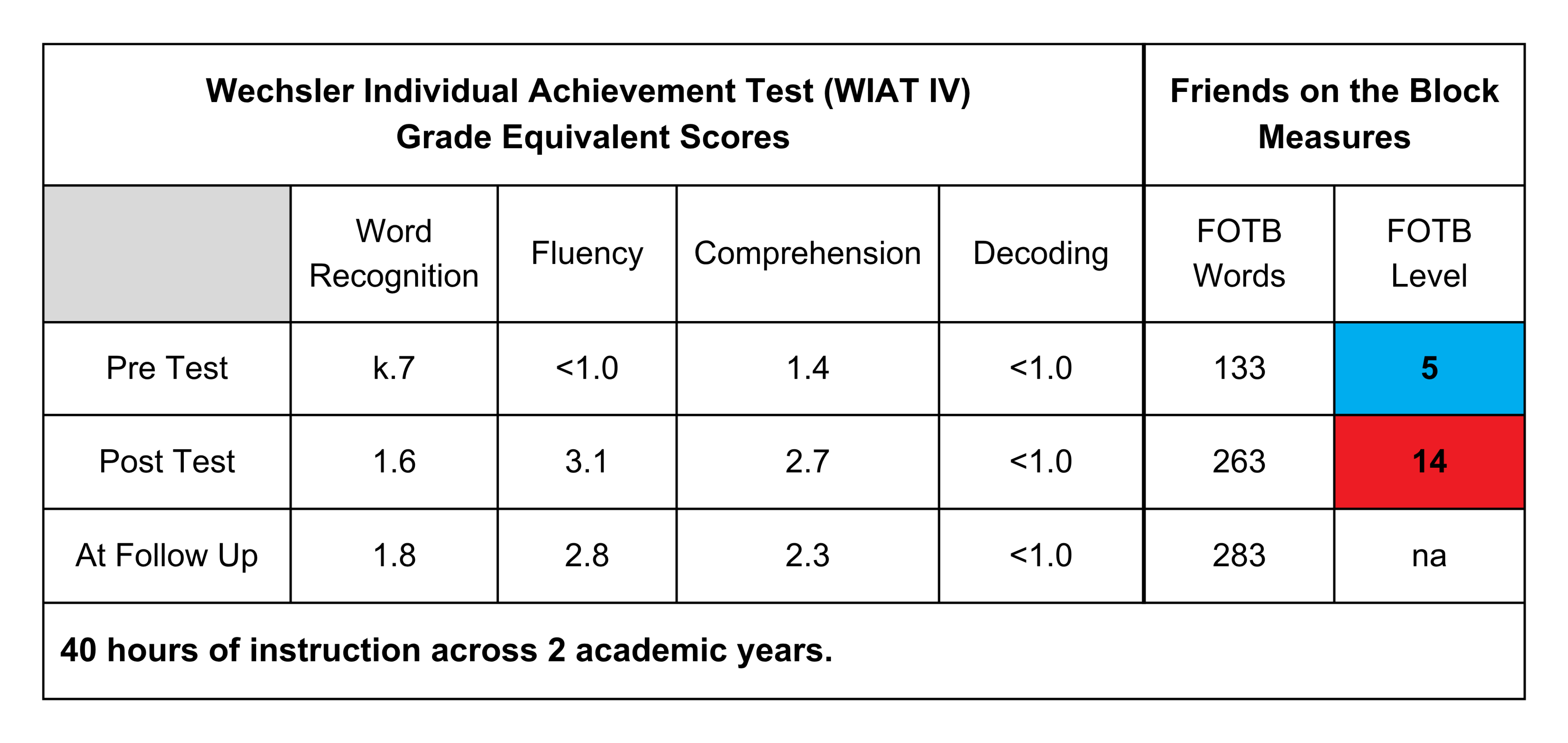
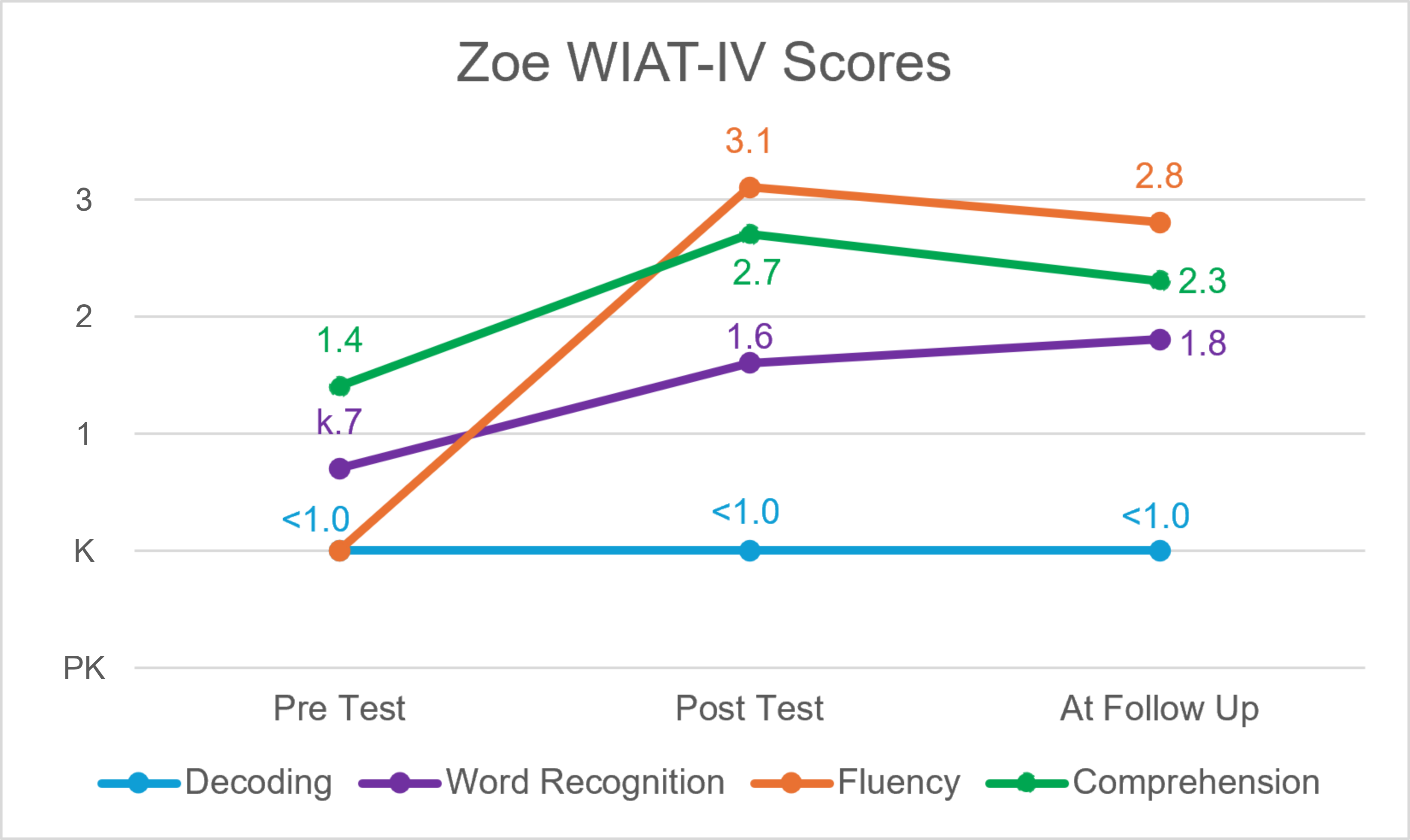
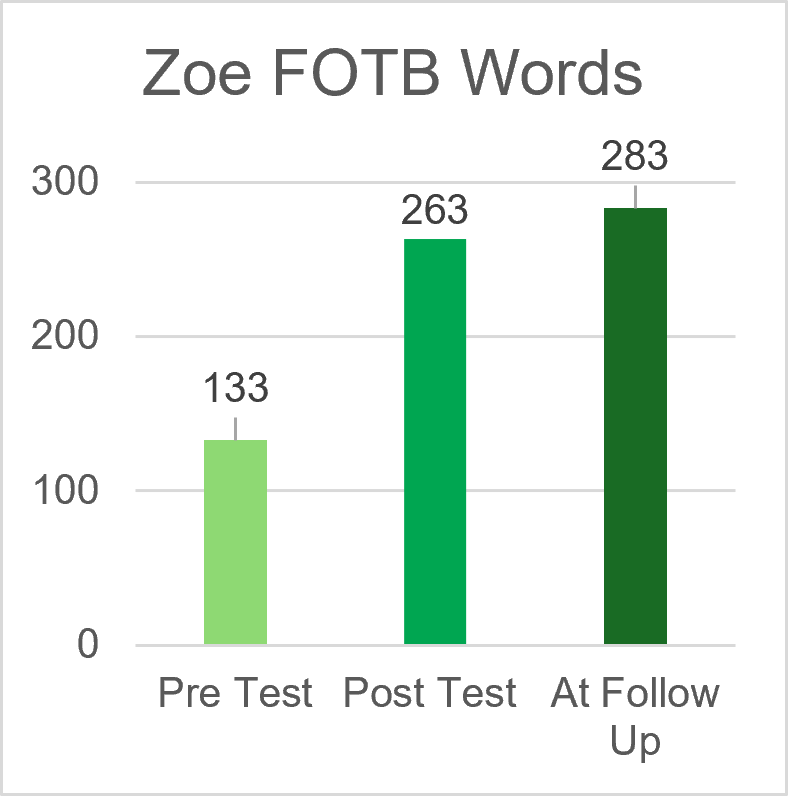
As shown in the table and graphs, Zoe made gains from pretest to posttest in word recognition, fluency, and comprehension, maintaining those gains at follow-up approximately one year later. At posttest, Zoe's grade-equivalent* scores indicated that she performed similarly to a student in the middle of first grade in word recognition, early third grade in fluency, and late second grade in comprehension. Zoe performed less well on the nonsense-word decoding measure. However, during passage reading and lesson activities, she demonstrated the ability to decode and encode words containing letter patterns taught in FOTB. See the Target Word List and Phonics Patterns for details. On the CUBED Narrative Language (Petersen & Spencer, 2016) measure administered at posttest, she read third-grade text at 77 words per minute with 93% accuracy and responded correctly to 13 out of 14 comprehension questions.
Response to Lesson Features and Customization
Zoe's progress illustrates how customized placement, pacing, and instructional support can promote engagement and learning. Her placement assessment identified a starting level that included some Target Words she already knew, allowing her to experience early success. Immediate corrective feedback, scaffolding, and encouragement from her teacher helped build her confidence.
Initially, Zoe tended to rush, making errors without recognizing them. For example, she might read "like" instead of "look" without catching her mistake. With consistent immediate corrective feedback, scaffolding, and encouragement to slow down, she became more consistent and increasingly practiced sounding out words as she read. Advancing to new levels provided additional opportunities to experience success and strengthen her confidence. Customized pacing allowed Zoe to progress as she demonstrated mastery of the instructional content, rather than spending the same amount of time on every level. She completed all 14 levels in 40 hours of instruction, illustrating how customized pacing can support progress through a structured literacy program.
During her final week of instruction, Zoe demonstrated her increased fluency and accuracy as she read a Level 13 FOTB passage at 133 words per minute with 97% accuracy during the Fluency Building Routine. Sample text from this passage is in the left column.
*Note: Grade equivalent scores provide a comparison with students in the norming sample but do not necessarily indicate mastery of all skills at a given grade level.